

Every foam ear plug review you'll find online, including the long-term one I wrote after wearing a pair to bed for six months straight, tells you how well the product worked once it was properly in. Almost none of them tell you what happens before that. A real share of the people who buy Flents foam ear plugs try them once, get almost no noise reduction, and quietly conclude the product doesn't work. In my experience testing this pair against several other buyers with different ear shapes, it almost never was broken. It usually never had a real seal to begin with, and no NRR number printed on the package can fix a plug that isn't actually sealing anything.
This is the honest version of that review, the one that starts from skepticism instead of from a pair I already liked. I'm not walking back my long-term take on Flents. The foam still recovers its shape night after night and it's still what I reach for most evenings. But an honest reviewer owes you the parts that get glossed over in a glowing writeup: what the NRR rating actually measures and what it doesn't promise you, why a bad roll-and-insert wastes a perfectly good pair, how ear canal size quietly decides whether these work for you at all, what side sleeping really does to the seal, the hygiene tradeoffs nobody wants to mention, the fact that foam plugs mute your alarm clock along with the neighbor's dog, and who, honestly, should not bother with foam plugs at all.
The Quick Verdict
Flents foam plugs work as well as any foam plug can, but the NRR number oversells what most people will actually experience, and the technique gap between a good insert and a bad one is bigger than the gap between brands.
Amazon Check Today's Price →Before you write off another pack of earplugs that 'didn't work'
Most fit failures aren't the plug's fault. Flents foam ear plugs are cheap enough to test the technique fixes in this article without much risk if it turns out the fit still isn't right for you.
Amazon Check Today's Price on Amazon →How I Actually Tested These, Not Just Wore Them
For the long-term review, I wore one pair of Flents every night for six months and reported what changed. For this one, I went looking for failure points on purpose. I inserted a fresh pair the correct way for a week, then deliberately inserted them wrong for a few nights, rushing the roll and pressing them in before they'd thinned out fully, to see how much of the noise reduction actually depends on technique rather than the product itself. The difference was not subtle. A rushed, under-rolled plug let in enough sound that I might as well not have bothered.
I also compared notes with my partner, whose ear canals run noticeably smaller and more curved than mine, over the same stretch of nights. We used the same box, the same room, the same noise source, and got meaningfully different results, which told me a lot of what gets blamed on a specific brand is actually a mismatch between a standard foam shape and a non-standard ear. That comparison is the backbone of everything below.
I also tested across different settings rather than just my own bedroom, since a lot of noise problems aren't static. A week in a hotel with paper-thin walls, a few nights near a noisy street vent, and my usual bedroom gave me three very different noise floors to check the plugs against. The technique held up consistently everywhere; the fit variability I noticed came from the ear, not the room, which is part of why I'm confident that's the real story here rather than an inconsistent product.
What an NRR Number Actually Promises, and What It Doesn't
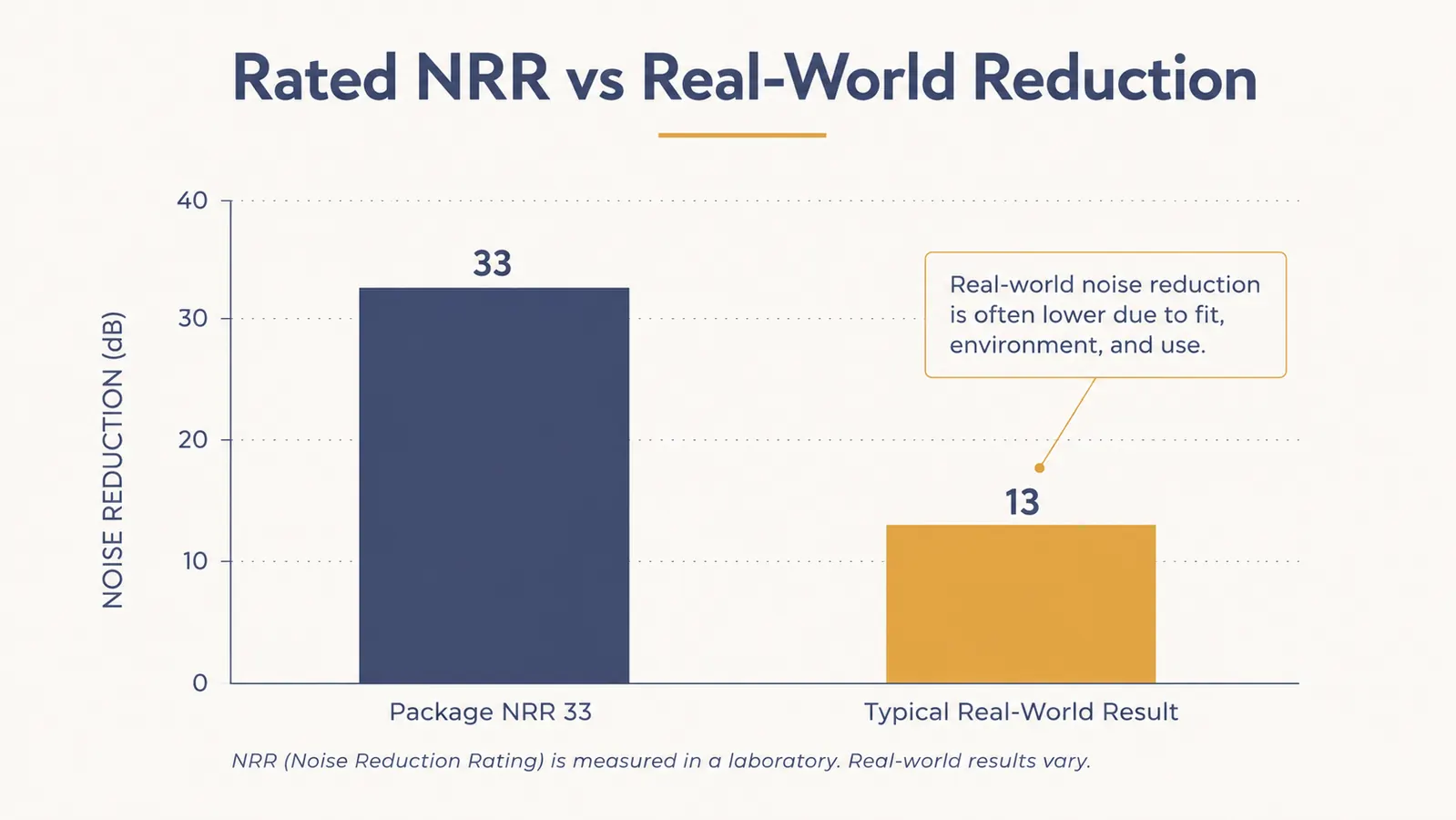
Flents lists a Noise Reduction Rating of 33 on the package, and that number is real. It's the manufacturer's own lab-tested figure, measured under controlled conditions with plugs fitted by trained testers who know exactly how to roll and seat foam correctly. What that number does not promise is that you, in a real bedroom, half asleep, using one hand in the dark, will get anywhere close to a 33-decibel reduction on your first try, or your fiftieth.
Occupational safety guidance for hearing protection generally tells you to derate a printed NRR substantially before trusting it in real-world conditions, precisely because lab fit is close to ideal and daily-life fit rarely is. I'm not a safety inspector and this isn't medical advice, just plain math: treat the number on the box as a ceiling, not a guarantee, and judge the plug by what you actually hear once it's seated, not by the rating printed above the barcode.
For shopping purposes, the practical takeaway is to use NRR as a rough sorting tool between products rather than a literal promise. A plug rated 33 will generally outperform one rated 22 once both are seated correctly, but the gap between two plugs both rated in the low thirties is unlikely to matter as much as whether you actually got a full seal on the one you're wearing tonight. Chasing an extra point or two of NRR is usually less useful than spending thirty extra seconds getting the insert right.
Why a Bad Roll-and-Insert Makes an Expensive Plug Worthless
The single biggest variable in how well any foam plug performs, Flents included, is technique, not price. A proper insert means rolling the foam down into a thin, even cylinder with clean, dry fingers, pulling the outer ear up and back to straighten the canal, pushing the plug in far enough that it sits inside the canal rather than just plugging the opening, and then holding it in place with a fingertip for a full twenty to thirty seconds while it expands. Skip any one of those steps and you get a plug that looks inserted but isn't actually sealed.
The most common mistake I watched myself and my partner make, especially on tired nights, was letting go too soon. The foam expands from the inside out, so the first few seconds after insertion feel done even though the outer edge hasn't finished sealing yet. A ten-dollar plug inserted correctly will outperform a premium plug inserted in a hurry, every single time. If you've tried foam plugs before and given up, technique is the first thing I'd suspect before blaming the product.
Ear Canal Size and the Fit Failure Nobody Warns You About
Foam plugs are a one-size product solving a problem that isn't actually one size. Ear canal diameter and curvature vary a lot from person to person, and Flents, like most foam brands, is shaped and sized for an average canal rather than a specific one. For me, the standard contour shape seals easily. For my partner, with narrower canals, the same pair needs a slightly tighter, more careful roll to seat fully, and even then the seal feels less complete than mine does on an identical night.
If you've genuinely nailed the roll-and-insert technique and you're still not getting real noise reduction, the honest next step is trying a different plug shape or a slightly denser foam before assuming foam plugs as a category are a lost cause. Some people's canals are simply outside the range a standard contour plug seals well against, and that's a fit issue, not a defect.
Before giving up on foam entirely, it's worth trying a couple of variables: a slower, tighter roll that makes the cylinder thinner than feels natural at first, and if that still doesn't seal, a different shape entirely, since some brands run narrower or use a firmer foam that holds its rolled shape longer while you get it seated. That single change closed the fit gap for my partner more than switching brands ever did.
Side-Sleeper Pressure, the Complaint Nobody Puts in the Headline
The low-profile contour shape on these is genuinely better for side sleeping than a lot of bulkier foam plugs, and I said as much in the long-term review. What I didn't dwell on there is that 'better' isn't the same as 'no pressure at all.' On restless nights, especially when I'm sleeping fully on my ear rather than at an angle, I still notice a dull ache by morning, and it's worse on the side I favor when I'm congested or sleeping in an unfamiliar bed.
This isn't unique to Flents. Any foam sitting between a pillow and a jawbone for eight hours is going to create some pressure eventually, and side sleepers who are especially sensitive to it should expect an adjustment period, not a pain-free night one. If you already know pillow pressure on your ear bothers you specifically, that's worth weighing before you buy a bulk pack expecting zero discomfort.
The Hygiene Reality Most Reviews Skip Entirely
Foam ear plugs sit inside your ear canal, absorb skin oil and a small amount of ear wax every night, and are cheap enough that most brands, Flents included, expect you to throw a pair away every few nights rather than treat them as a long-term reusable item. The honest problem is that plenty of buyers don't do that. A pair left in a jacket pocket or a bathroom drawer for two weeks and reused nightly is not the same product, hygienically, as a fresh one out of the box.
My own routine, worked out during the six-month test, is a clean dish for fresh pairs and a separate spot for used ones, with a hard rule of tossing anything that feels tacky or gritty rather than smooth. That's common sense, not medical advice, but it's the kind of habit that determines whether a cheap plug stays a genuinely comfortable nightly product or turns into something you're quietly reusing past the point it should be.
I also stopped sharing a box with anyone during a cold or sinus infection, which sounds obvious written out but is easy to forget when the dish is sitting right there on a shared nightstand. Basic care like washing hands before rolling a fresh pair and not reusing one that's been sitting loose in a bag for days isn't complicated, but it's the difference between foam plugs staying a low-maintenance habit and becoming something you regret.

They Mute Your Alarm Clock Too, and What to Do About It
This is the tradeoff nobody puts on the front of the package. A plug good enough to block a snoring partner or street noise is also good enough to blunt a standard phone alarm, and on a couple of mornings during this test I genuinely slept through the first alarm cycle entirely and only woke up when my partner nudged me. If you're a light sleeper who relies on foam plugs specifically because you wake up too easily, you've also just made yourself harder to wake up on purpose, which matters if you have somewhere to be.
The fixes are simple and worth setting up before your first full night, not after you've overslept once. A bed-shaker alarm or vibrating wristband gets through where sound doesn't. Setting a phone alarm loud, close to your head, and on a rising volume pattern helps too. And if a snoring partner is the reason you're wearing plugs in the first place, my full walkthrough on fitting foam plugs correctly to block snoring without losing your alarm entirely covers this exact tradeoff in more detail.
What I Liked
- Comfortable enough for side sleeping once you accept some pressure on restless nights
- Cheap enough to test technique fixes without real financial risk
- Genuinely blocks steady noise like traffic and snoring once seated correctly
- Contour shape works well for average canal sizes without much adjustment
Where It Falls Short
- The NRR 33 on the package is a lab number, not a real-world guarantee
- A rushed roll-and-insert wastes most of the plug's performance
- Standard sizing doesn't fit every ear canal equally well
- They mute alarms along with everything else, which needs a backup plan
- Not a fit for anyone who can't tolerate sustained pressure in the ear canal
The plug isn't the variable most people get wrong. The thirty seconds after you insert it are.
Who This Is For
This is a solid pick for light sleepers dealing with steady, predictable noise, a snoring partner, street sounds, thin apartment walls, who are willing to learn the correct roll-and-insert technique and actually replace pairs on a regular cadence. It's also a reasonable option for anyone who's tried a cheaper, generic foam plug and gotten inconsistent results, since Flents holds its shape and seal more reliably than the lowest-cost store brands I've compared it against side by side. If you want a broader read on how foam stacks up against a completely different approach, my comparison of foam plugs against noise cancelling headphones for sleep lays out where each one actually wins.
It's not a good fit, on the other hand, for anyone hoping a single purchase solves the problem without any learning curve. The people who get the most out of this pair are the ones willing to spend one or two nights actually paying attention to the roll and the seal instead of jamming a plug in half asleep and blaming the product the next morning when it didn't work.
Who Should Genuinely Skip Foam Plugs Entirely
If you have a history of ear infections, drainage, or any ongoing ear canal sensitivity, foam plugs are not the product to experiment with, and that's a conversation for a doctor, not a review site. Anyone who needs to reliably hear a baby monitor, a smoke alarm, or someone calling for them overnight should think hard before muting that channel, alarm workaround or not. People with very narrow, curved, or previously injured ear canals may never get a comfortable seal no matter how well they master the technique, and forcing it isn't worth the discomfort. And if the idea of tossing a pair every two or three nights and replacing them on a schedule feels like more upkeep than you want, an over-the-ear option is honestly the better match for how you actually live, not a stubborn insistence on making foam work.
If the technique fixes above solve it, this is still the pair worth having on hand.
Flents foam plugs are inexpensive enough to actually test the roll-and-insert fixes in this review before deciding foam isn't for you.
Amazon Check Today's Price on Amazon →